You used to type a question into Google, scroll through ten blue links, and click one. That’s not how search works anymore.
Now you might ask ChatGPT instead. Or Google answers you directly with an AI Overview before you even see a website. Or Perplexity gives you a full summary with sources baked in.
This shift has created a lot of new marketing acronyms and a lot of confusion. SEO. AEO. GEO. Are they the same thing? Do you need all three? Is old-school SEO even worth doing anymore?
This guide breaks it all down in plain language, so you know exactly what each one means and how to use them together in 2026.
Table of Contents
- What Is SEO?
- What Is AEO (Answer Engine Optimization)?
- What Is GEO (Generative Engine Optimization)?
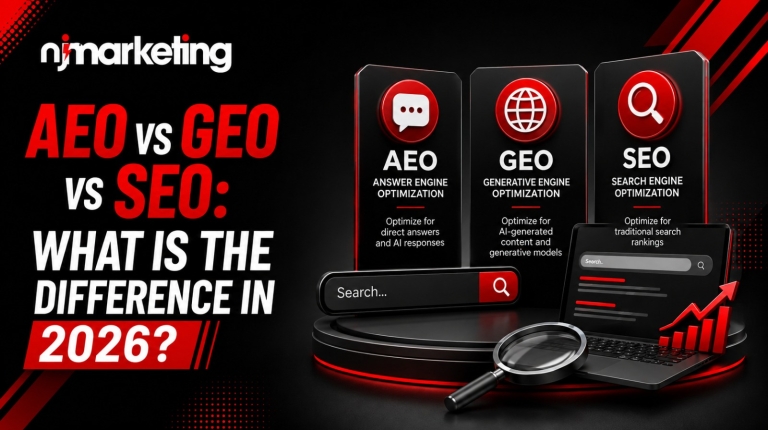
- AEO vs GEO vs SEO: Side-by-Side Comparison
- The Key Differences, Explained Simply
- Why This Matters in 2026
- Do You Need All Three?
- How to Optimize for SEO, AEO, and GEO Together
- Common Mistakes to Avoid
- FAQs
- Final Thoughts
What Is SEO?
SEO stands for Search Engine Optimization. It’s the original discipline — the one marketers have been doing for over two decades.
In simple terms, SEO is the practice of improving your website so it ranks higher on search engines like Google and Bing. Higher rankings mean more visibility. More visibility means more clicks. More clicks (ideally) mean more customers.
SEO relies on a mix of things working together:
- On-page SEO: titles, headings, and content that clearly match what people are searching for
- Technical SEO: site speed, mobile-friendliness, crawlability, and clean site structure, the kind of foundation NJ Marketing’s Technical SEO service is built around
- Content quality: depth, originality, and usefulness of your pages
- Backlinks: other trustworthy sites linking back to you, which is where a dedicated Link Building strategy comes in
- User experience: how easily visitors can find what they need once they land
SEO works best when someone already knows roughly what they want and is comparing options, think “best web design agency Mississauga” or “affordable SEO services near me.” If you’re weighing whether to bring this in-house or bring in outside help, our breakdown of the benefits of hiring an SEO agency for a small business covers that decision in more detail.
Is SEO dead in 2026? No. It’s still the foundation everything else is built on. AI tools don’t pull content out of thin air; they still favor pages that are well-structured, credible, and technically sound. Weak SEO undermines AEO and GEO too.
What Is AEO (Answer Engine Optimization)?
AEO stands for Answer Engine Optimization. It’s the practice of structuring your content so it can be pulled out and shown as a direct answer not just a link on a results page.
Think about:
- Featured snippets on Google
- “People Also Ask” boxes
- Voice assistant responses (Siri, Alexa, Google Assistant)
- Google’s AI Overviews
With AEO, the goal isn’t just to rank it’s to be the answer itself, often without the user ever clicking through to your site.
To win at AEO, content typically needs to:
- Answer the question in the first sentence or two, then explain further
- Use clear, question-based headings (a lot like this article)
- Be formatted in short, extractable chunks lists, tables, and short paragraphs
- Include structured data (schema markup) that helps machines understand what your content is answering, which is exactly what we cover in how schema markup can boost your local SEO.
AEO works best for informational searches the “what,” “how,” and “why” questions people ask before they’re ready to buy.
What Is GEO (Generative Engine Optimization)?
GEO stands for Generative Engine Optimization. This is the newest of the three, and the one most businesses are still figuring out.
GEO is about optimizing your content and brand presence so that generative AI tools ChatGPT, Google Gemini, Perplexity, Claude cite, mention, or recommend you when someone asks a related question.
Here’s the important distinction: unlike Google, these AI tools don’t hand back a list of links. They synthesize an answer from multiple sources into a single response. GEO is about earning a spot inside that synthesis.
A few things make GEO different from traditional SEO:
- It’s less about your website and more about your reputation across the internet — reviews, mentions, forums, press, and other third-party sources
- Freshness matters enormously AI tools tend to favor recently updated content over older, stale pages
- There’s no single “ranking position” to chase the same question can produce different AI answers depending on the platform, the day, and the user’s location
Worth knowing: in the industry right now, AEO and GEO are sometimes used almost interchangeably. AEO leans more toward being the extractable answer (snippets, voice, AI Overviews), while GEO leans more toward being the cited source inside a fully generated AI response. The terminology is still settling but the underlying skill set overlaps heavily.
AEO vs GEO vs SEO: Side-by-Side Comparison
Here’s the quickest way to see how they differ:
| Factor | SEO | AEO | GEO |
| Main goal | Rank in search results | Be the direct answer shown | Be cited inside AI-generated answers |
| Platforms | Google, Bing | Featured snippets, voice search, AI Overviews | ChatGPT, Gemini, Perplexity, Claude |
| Content style | Keyword-relevant, in-depth pages | Answer-first, structured, scannable | Authoritative, fact-dense, easy to quote |
| User behavior | Clicks through to your site | Often gets the answer without clicking | Almost always zero-click |
| What you’re measured on | Rankings, organic traffic | Snippet and voice appearances | Frequency of AI mentions and citations |
The Key Differences, Explained Simply
If tables aren’t your thing, here’s the plain-English version:
- SEO is like getting your product placed on the store shelf where shoppers can find it.
- AEO is like being the item the store clerk personally recommends when someone asks a question.
- GEO is like being the brand a friend mentions by name even when you’re not in the store at all.
All three are about visibility. They just operate on different “surfaces” of the modern search experience.
One more distinction worth remembering:
- SEO is largely a first-party game. You control your website, your content, your technical setup.
- GEO is largely a third-party game. AI tools pull heavily from sources across the entire internet, including reviews, articles, forums, other websites not just your own domain.
That’s a big mental shift for a lot of businesses used to thinking only about their own site.
Why This Matters in 2026
Search behavior has changed faster in the past two years than in the previous decade combined.
Consider what’s happening right now:
- A large and growing share of searches end without the user clicking any website at all
- AI Overviews now appear across a meaningful portion of Google searches, sitting above traditional results
- Chat-based AI tools like ChatGPT and Gemini have grown into some of the most-used platforms for finding information many people start their research there instead of Google
- Younger audiences especially are shifting toward asking AI tools questions directly, rather than searching and scrolling
Here’s the real consequence: if your business only optimizes for traditional SEO, you’re competing for a shrinking share of user attention. The businesses winning in 2026 are showing up everywhere their audience actually looks at search results, AI Overviews, and AI chat responses.
Do You Need All Three?
Yes. SEO, AEO, and GEO aren’t competing strategies; they’re layers of the same visibility strategy, each covering a different part of the customer’s search journey.
Here’s why skipping any one of them creates a blind spot:
- Skip SEO, and you lose the traffic that still comes from traditional search which remains substantial
- Skip AEO, and you miss the growing number of users who get their answer without ever seeing a list of websites
- Skip GEO, and your competitors could be the ones getting recommended by name inside AI chat conversations while you’re invisible
The good news: you don’t necessarily need three separate content strategies. One well-structured, genuinely useful piece of content written clearly, backed by real expertise, and formatted for easy extraction can often perform well across all three at once.
How to Optimize for SEO, AEO, and GEO Together
Here’s a practical checklist to start building visibility across all three:
- Structure content in an answer-first format. Lead with the direct answer, then explain the details. This helps both human readers and AI systems.
- Add schema markup. FAQ schema, Article schema, and Organization schema all help search engines and AI tools understand and trust your content.
- Build topical authority. Instead of one shallow page, create genuinely deep, well-organized content that covers a topic from multiple angles, the same approach we outline in our CEO’s guide to content marketing.
- Keep content fresh. Update statistics, examples, and dates regularly AI tools strongly favor recently updated, accurate information.
- Earn mentions beyond your own website. Reviews, guest posts, press coverage, and community discussions all feed GEO, since AI tools pull heavily from third-party sources.
- Track AI referral traffic. Check for visits coming from chatgpt.com and perplexity.ai inside your analytics, and manually test how your business shows up when you ask AI tools relevant questions.
- Prioritize genuine expertise. Content written by real experts, with clear authorship and credibility signals, performs better across all three disciplines; this is the E-E-A-T principle Google has emphasized for years, and AI tools apply similar trust signals.
Common Mistakes to Avoid
A lot of businesses stumble in the same few places:
- Treating SEO, AEO, and GEO as identical. They overlap, but they require different formatting and different priorities.
- Ignoring GEO completely. While you wait and watch, competitors may already be building authority inside AI tools.
- Over-optimizing for AI at the expense of traditional search. Google still drives significant traffic, don’t abandon it.
- Skipping structured data. Schema markup isn’t optional anymore; it’s one of the clearest signals you can give machines about what your content means.
- Writing for algorithms instead of people. Ironically, the content that performs best across SEO, AEO, and GEO is content that genuinely, clearly answers a real human question not content stuffed with repeated keywords.
FAQs
What is the difference between AEO, GEO, and SEO in simple terms?
SEO gets your website ranked in search results. AEO gets your content selected as a direct answer. GEO gets your brand cited inside AI-generated responses.
Is GEO replacing SEO in 2026?
No. GEO and AEO build on top of SEO they don’t replace it. Search engines and AI tools both still favor content that’s technically sound, well-structured, and authoritative.
Which matters more for small businesses SEO or AEO?
It depends on your audience. If customers are comparing options and ready to buy, SEO still drives strong results. If customers are asking research-style questions, AEO becomes more valuable. Most small businesses benefit from doing both.
How do I optimize content for ChatGPT and Gemini?
Focus on clear, fact-based, well-organized content; keep information current; and build your presence across third-party sites, since these tools draw heavily from sources beyond your own website.
Do I need separate content for SEO, AEO, and GEO?
Usually not. One well-structured, genuinely useful page answer-first, clearly formatted, backed by real expertise can perform across all three.
How is AI search performance measured?
There’s no single standardized metric yet. Most businesses track AI referral traffic in their analytics and manually test how they show up across different AI platforms for key questions.
Final Thoughts
Search isn’t one thing anymore it’s split across traditional results, AI-generated answers, and AI chat conversations. SEO gets you ranked. AEO gets you the answer spot. GEO gets you cited by the AI tools your customers are increasingly turning to first.
None of these acronyms is going away, and none of them works well in isolation. The businesses staying visible in 2026 are the ones treating SEO, AEO, and GEO as one connected strategy, not three separate boxes to check.
Not sure where your brand currently stands across Google, ChatGPT, and Perplexity? NJ Marketing’s AEO & GEO team can audit your current visibility and build a strategy that keeps you found wherever your customers are searching. Book a free strategy call to get started.