You open a website and type, “Where’s my order?” The chatbot replies, “Sorry, I didn’t understand that.”
You try again. Same answer. By the third attempt, you’re looking for a phone number.
That’s a rule-based chatbot reaching its limits. Now picture a chatbot that can interpret what you’re asking, request your order number, and provide a delivery update when it’s connected to the right system. That’s where an AI chatbot can offer a different experience.
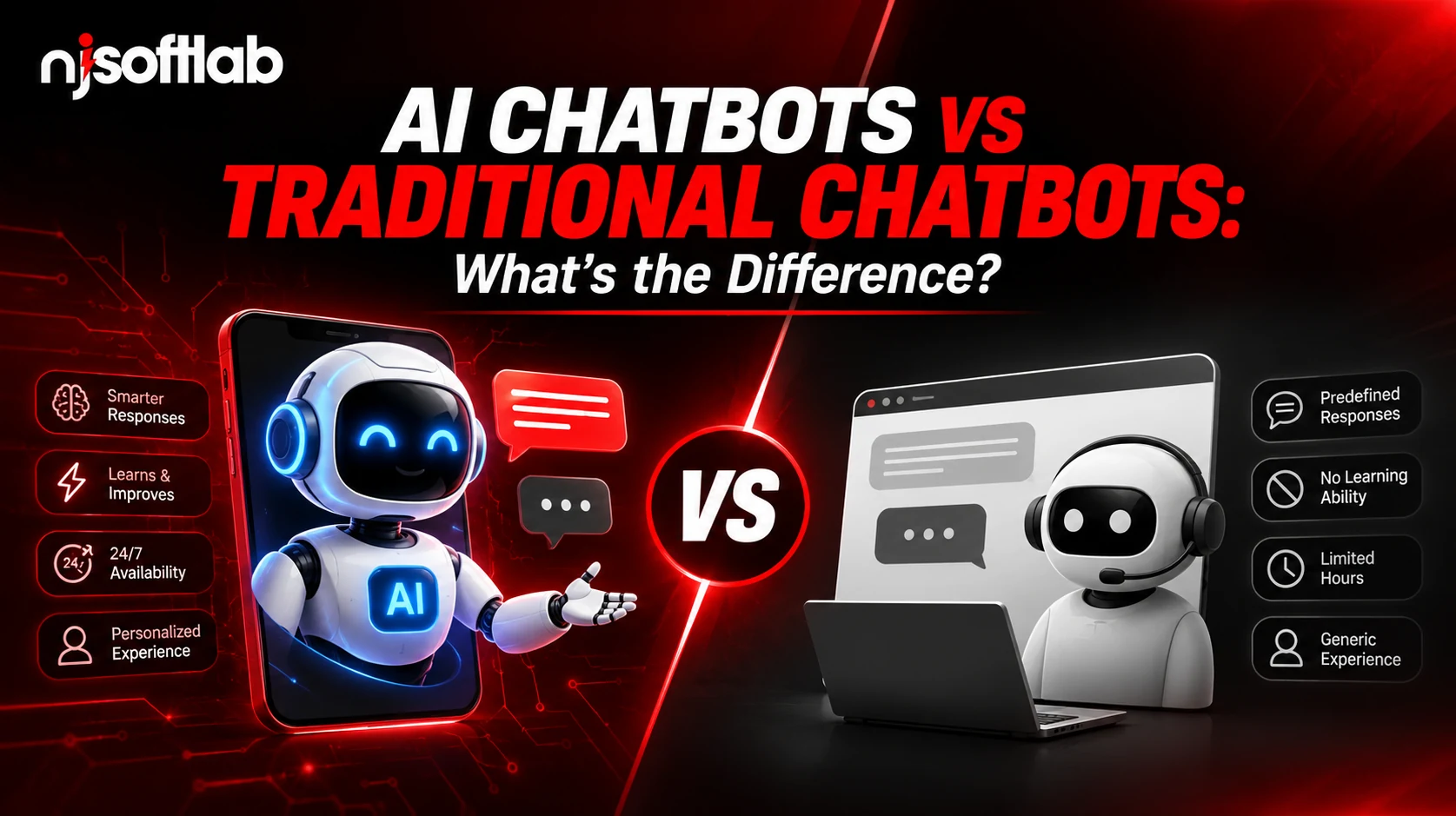
Quick answer: The main difference between AI chatbots and traditional chatbots is how they handle user input. Traditional chatbots follow predefined rules, scripts, or decision trees. AI chatbots use technologies such as machine learning and large language models to process language, consider context, and generate responses.
In this guide, you’ll learn:
- How traditional and AI chatbots work
- The key differences between them
- What happens when both receive the same question
- When a rule-based chatbot is still the better choice
- The risks and limitations of AI chatbots
- How to choose the right approach for your business
What Is a Traditional (Rule-Based) Chatbot?
A traditional chatbot operates using rules and responses that are created in advance. When a user provides certain input, the chatbot follows a predefined path and returns a programmed response.
Most traditional chatbots use one or more of these approaches:
- Keyword matching: The chatbot identifies words such as “refund” or “shipping” and displays a relevant response.
- Buttons and menus: Users select options such as “Track order,” “Returns,” or “Talk to an agent.”
- Decision trees: Each answer sends the user to the next step in a predefined conversation flow.
Think of it like a vending machine. Press B4 and you get the product assigned to B4. Ask for “something salty” and the machine cannot interpret the request.
What Traditional Chatbots Do Well
- They’re generally cheaper and faster to set up.
- Their responses are predictable and easy to control.
- They’re relatively simple to test and maintain.
- They work well for repetitive, straightforward tasks.
Where Traditional Chatbots Fall Short
- They can struggle when users phrase questions differently from their programmed rules.
- Their ability to maintain conversational context is limited.
- New topics often require additional rules, flows, or responses.
- Complex or unexpected questions may result in a fallback response.
What Is an AI Chatbot?
An AI chatbot uses artificial intelligence to process user input and generate responses. Instead of relying entirely on predefined scripts, it can use language models to interpret requests and respond based on the available context and information.
Modern AI chatbots can use technologies such as:
- Natural language processing (NLP): Techniques that help computer systems process and work with human language.
- Machine learning: Methods that allow systems to identify patterns from data and improve their performance through training.
- Large language models (LLMs): AI models trained on large amounts of text that can generate and process natural-language responses.
The important difference is how the chatbot handles language.
A rule-based chatbot may look for specific words or follow a fixed conversation path. An AI chatbot can process the broader meaning of a request and generate a response based on the context available to it.
For example, these questions could have the same intent:
- “My parcel is late.”
- “Where is my package?”
- “My delivery hasn’t arrived.”
- “Can you check my order?”
An AI chatbot can be designed to recognize that these requests are related, even though the wording is different.
A chatbot communicates with users, while an AI agent can go further by taking actions such as booking a meeting, updating a record, or triggering a workflow. If you’re interested in this distinction, read our guide to agentic AI.
AI Chatbots vs Traditional Chatbots: Key Differences
Here’s a quick comparison:
Feature | Traditional Chatbot | AI Chatbot |
Technology | Rules, keywords, decision trees | AI models, NLP, LLMs |
Understanding | Matches programmed inputs | Processes language and context |
Conversation flow | Mostly predefined | More flexible |
Complex questions | Limited | Can handle more varied requests |
Context | Usually limited | Can maintain context when designed to do so |
Personalization | Usually basic | Can be personalized with relevant data |
Setup | Generally simpler | Requires more planning and integration |
Maintenance | Manual rule updates | Monitoring, updates, testing, and data management |
Cost | Usually lower upfront | Usually higher upfront |
Risk | Limited responses | Can generate inaccurate responses |
Let’s look at the differences that matter most.
1. Understanding What People Mean
A traditional chatbot may depend heavily on specific keywords or predefined options.
For example, a user who types “cancel my subscription” may trigger the correct workflow. But “I don’t want to be charged anymore” might not work if that wording hasn’t been accounted for.
An AI chatbot can process the broader meaning of the request and potentially identify the user’s intent even when the wording changes.
2. Flexibility in Conversation
Rule-based chatbots generally guide users through predefined paths. If the user moves outside that path, the chatbot may return an error or ask them to start again.
AI chatbots can support more flexible conversations. Users can ask follow-up questions, provide additional details, or phrase their requests naturally, depending on how the chatbot has been built.
3. Personalization
Traditional chatbots often provide the same response to users who follow the same path.
An AI chatbot can be connected to systems such as a CRM, ecommerce platform, or booking system. With the appropriate permissions and integrations, it can use relevant customer information to provide a more personalized response.
For example, instead of simply saying “Please check your order status,” a properly integrated chatbot could retrieve the status of a specific order and explain the next step.
4. Learning and Maintenance
It’s common to hear that AI chatbots “learn from every conversation.” That’s not necessarily how business chatbots work.
Most business AI chatbots don’t automatically retrain themselves on every live conversation. They may improve when developers update their knowledge sources, prompts, instructions, models, or configurations.
Traditional chatbots also require ongoing maintenance, but that usually involves updating rules, conversation flows, buttons, and predefined responses.
Both types require monitoring. The difference is in what needs to be maintained.
Same Question, Two Chatbots: A Simple Example
Let’s test both approaches with the same message:
“I ordered shoes last week and they still haven’t arrived. Can you help?”
Traditional Chatbot
A traditional chatbot might:
- Identify keywords such as “order” or “shoes”
- Display options such as “Track order,” “Returns,” or “Other”
- Ask the user to select a predefined option
- Return a fallback response if the request doesn’t match its rules
AI Chatbot
An AI chatbot could:
- Identify that the customer is asking about a delayed order
- Ask for an order number
- Retrieve delivery information if connected to the store’s system
- Explain the current delivery status
- Escalate the conversation to a human agent when necessary
The difference isn’t simply that one chatbot is “smart” and the other isn’t. The important factor is what each system is designed and connected to do.
When Does a Traditional Chatbot Still Make Sense?
Traditional chatbots aren’t outdated. For some business tasks, they’re still the better option.
Choose a rules-based chatbot when:
- Most questions are simple and repetitive.
- You need exact, approved wording.
- The chatbot handles a small number of predictable tasks.
- The process follows a fixed workflow.
- Your budget is limited.
- You prefer a controlled fallback instead of a generated response.
For example, a small clinic that only needs a chatbot to help visitors select an appointment type and submit a booking request may not need a sophisticated AI system.
When Is an AI Chatbot the Better Choice?
AI can be a better fit when conversations are varied and require more context.
Consider an AI chatbot when:
- Customers ask many different types of questions.
- Users phrase the same request in different ways.
- You support multiple languages.
- You want to qualify leads through conversational questions.
- Your support team handles a large volume of repetitive conversations.
- The chatbot needs to work with information from a CRM, ecommerce platform, booking system, or other business application.
- You want customers to have a more conversational support experience.
The right implementation matters. An AI chatbot isn’t automatically useful simply because it uses an LLM.
What Are the Risks and Limitations of AI Chatbots?
AI chatbots can provide more flexible interactions, but they also introduce risks that businesses need to manage.
Wrong or Inaccurate Answers
AI models can sometimes generate information that sounds convincing but is incorrect. This is often referred to as a hallucination.
Businesses can reduce this risk by:
- Limiting responses to approved information where appropriate
- Using reliable knowledge sources
- Adding instructions and guardrails
- Testing the chatbot with realistic questions
- Monitoring conversations after launch
- Providing human escalation for sensitive situations
Privacy
Businesses should carefully consider what information a chatbot collects, stores, and processes.
Users should avoid sharing sensitive information such as passwords, banking credentials, or unnecessary personal information.
Businesses should also have appropriate privacy and data-handling practices in place before deploying a chatbot.
Security
AI systems can face security risks, including attempts to manipulate the chatbot into revealing information or ignoring its instructions. One example is prompt injection.
A proper cybersecurity assessment can help identify potential risks around data access, integrations, authentication, and chatbot behavior.
Human Backup
A chatbot shouldn’t become a dead end for customers who need help with something it cannot handle.
Providing a clear option to reach a human agent is particularly important for complex, sensitive, or high-value customer interactions.
What Is a Hybrid Chatbot?
You don’t always have to choose between traditional and AI chatbots.
A hybrid chatbot combines rule-based workflows with AI capabilities.
For example:
- Rules can handle sensitive or exact processes such as account changes and payment-related workflows.
- AI can handle open-ended questions and more natural conversations.
- Human agents can take over when the chatbot reaches its limits.
This approach can provide greater control while still giving users a more flexible conversational experience.
For many businesses, a hybrid model can be a practical option when they want AI capabilities without allowing AI to control every part of the customer journey.
How to Choose: AI Chatbot or Traditional Chatbot?
Ask yourself these four questions:
1. How Varied Are the Questions?
If customers usually ask the same few questions, a rule-based chatbot may be enough.
If users ask many different questions or regularly phrase requests in unexpected ways, AI may be more suitable.
2. How Fast Is Your Business Growing?
A simple chatbot can work well for a limited number of workflows. As the number of topics and conversation paths increases, maintaining large rule sets can become more difficult.
3. What Can You Spend and Maintain?
AI chatbots generally require more planning, development, testing, integrations, and ongoing monitoring.
The potential return depends on the business use case, so compare the expected benefits with the actual implementation and maintenance costs.
4. How Sensitive Is Your Data?
The more sensitive the information handled by the chatbot, the more important security, privacy, access controls, testing, and human oversight become.
Costs depend on the technology, number of conversations, integrations, data requirements, and level of customization. It’s better to get a quote based on your specific requirements than to rely on a generic chatbot price.
How NJ Softlab Can Help
NJ Softlab is a Toronto-based technology company providing AI, software, and cybersecurity solutions for businesses.
If you’re considering an AI chatbot, NJ Softlab can help with areas such as:
- Large language model integration for context-aware AI applications
- Generative AI services tailored to business requirements
- Agentic AI for AI systems that can perform tasks and workflows
- Cybersecurity considerations for protecting data and connected systems
The right chatbot depends on your goals, budget, data, and the complexity of the conversations you need to support.
Not sure which approach fits your business? Talk to the NJ Softlab team to discuss your requirements.
Frequently Asked Questions
What is the main difference between AI chatbots and traditional chatbots?
Traditional chatbots primarily follow predefined rules, scripts, or decision trees. AI chatbots use AI models, including large language models, to process natural language and generate responses based on available context.
Are traditional chatbots still useful?
Yes. Traditional chatbots work well for simple, repetitive, and predictable tasks such as FAQs, basic routing, appointment flows, and form collection.
Is ChatGPT a traditional chatbot?
No. ChatGPT is an AI chatbot that uses large language models to process and generate natural-language responses.
Do AI chatbots really learn from conversations?
Not necessarily. Most business AI chatbots don’t automatically retrain themselves from every live conversation. Their behavior can be improved through updates to models, knowledge sources, prompts, instructions, configurations, and testing.
Are AI chatbots safe to use?
AI chatbots can be deployed safely when businesses use appropriate security, privacy controls, testing, monitoring, guardrails, and human escalation. Users should also avoid sharing unnecessary sensitive information.
Which chatbot is cheaper to build?
Traditional rule-based chatbots are generally cheaper to build initially because they require less complex technology. AI chatbot costs can be higher because of model usage, integrations, development, testing, and ongoing monitoring.
Can an AI chatbot replace human customer support?
An AI chatbot can automate many repetitive support tasks, but it shouldn’t automatically replace human support. Human agents remain important for complex, sensitive, unusual, or high-value customer interactions.