
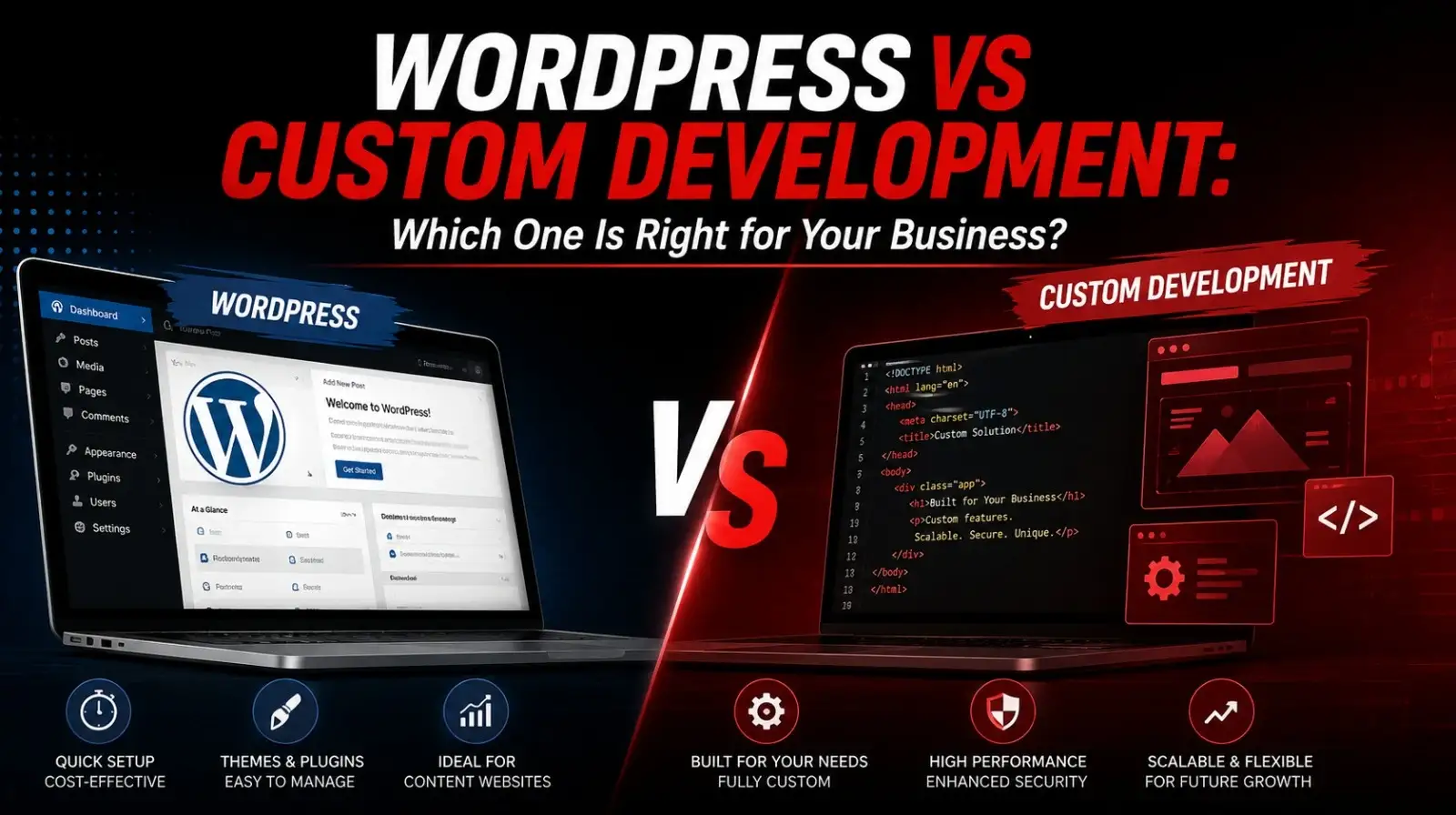
- Q: Is WordPress good enough for a business website in 2026? A: Yes, for most content-driven sites but it breaks down fast when you need unique workflows.
- Q: What does custom development actually cost more than WordPress? A: Custom builds typically cost 3x to 10x more upfront, but eliminate ongoing plugin and licensing fees.
- Q: When does WordPress become a liability instead of an asset? A: When your business logic requires features no plugin can replicate without major performance trade-offs.
- Q: Can a Canadian business switch from WordPress to custom later without losing SEO? A: Yes, with proper redirects and structured migration, but rebuilding mid-growth costs far more than choosing right the first time.
Quick Answer:
WordPress powers roughly 43% of all websites on the internet as of 2026, making it the most widely used CMS on the planet. For businesses that need a blog, brochure site, or standard e-commerce store, it delivers fast and affordably. Custom development, on the other hand, is purpose-built from scratch. It wins when your product requires unique data flows, security compliance, or performance that off-the-shelf plugins simply cannot match.
Over 43% of all live websites run on WordPress today, yet a growing number of Mississauga businesses are paying twice to rebuild what they launched on WordPress just two or three years ago. The Ontario tech market moves fast, and the platform decision you make in month one shapes your speed, security, and scalability for the next five years. Choosing wrong does not just cost money. It costs momentum.
What Is the Real Difference Between WordPress and Custom Development?
WordPress is an open-source content management system. You install it, pick a theme, add plugins, and go live, often within days. Custom development means engineers write your application’s code from the ground up, building only what your business needs, nothing else. This approach is particularly relevant when a project requires functionality beyond standard website features, which is where custom web development becomes a more suitable option. The confusion most business owners face is treating these two as versions of the same thing. They are not. WordPress is a pre-built platform you configure. Custom development is a product you design. The distinction matters because your growth ceiling changes completely depending on which path you take. In practical terms, WordPress is excellent when your needs map closely to what it was designed to do: publish content, run WooCommerce stores, and power marketing pages. For a broader look at how website-building approaches compare, see Custom Website or Template – What’s Best for Your Business?. Custom development earns its cost when your business logic, data structure, or user experience falls outside those boundaries.Is WordPress Good for a Business Website?
WordPress handles most standard business needs reliably. A professional services firm, a local restaurant, or a coaching business can launch a fast, SEO-friendly, mobile-responsive site on WordPress for a fraction of what custom development costs. If you are specifically evaluating WordPress development providers, Top 5 WordPress Development Company in Canada provides a related comparison. The platform has a mature ecosystem. There are over 59,000 plugins in the official WordPress directory as of 2026, covering everything from booking systems to CRM integrations. Most businesses never need anything beyond what those plugins offer, and that is perfectly fine. Where WordPress starts showing cracks is when you stack too many plugins to compensate for missing native functionality. Each plugin is a third-party dependency. Each one needs updates, creates potential conflicts, and adds database queries. A site running 40 or more active plugins can see page load times climb above three seconds, and Google’s own dataWhen Does WordPress Become the Wrong Choice?
The short answer: when your product is the website itself, not just the content on it. Businesses building SaaS platforms, custom booking engines, multi-vendor marketplaces, or data-heavy dashboards eventually hit a wall with WordPress. The platform was not engineered for complex application logic. You can force it to do those things with plugins and custom code bolted on top, but the result is fragile and hard to maintain. There is also the security angle. WordPress’s popularity makes it a constant target. Sucuri’s 2023 Website Threat Research Report found that WordPress accounted for 96.2% of all infected CMS websites they analyzed that year. That does not mean WordPress is insecure when managed properly, but it does mean the attack surface is enormous and requires active maintenance. For businesses handling sensitive financial or medical data in Ontario under PIPEDA or provincial privacy rules, that maintenance burden carries real legal weight. A custom-built application, by contrast, has no public-facing attack surface for automated scanners to probe, because there is no generic admin login page, no widely-known file structure, and no plugin vulnerabilities to exploit.How Much Does Custom Development Actually Cost?
Budget expectations are where most conversations either move forward or fall apart. A professionally built WordPress site in Canada typically runs between $3,000 and $15,000 depending on design complexity, custom theme work, and plugin configuration. Ongoing costs include hosting, premium plugin licenses, and maintenance, usually $100 to $500 per month. Custom web application development in the same market starts around $20,000 for a straightforward project and can reach $150,000 or more for something complex. However, you own every line of code. There are no licensing fees, no plugin renewal costs, and no dependency on a third-party developer’s update schedule. The business case for custom development improves sharply when you calculate total cost of ownership over three to five years. A $5,000 WordPress site that requires $400 a month in maintenance plus a $12,000 redesign in year three has cost $31,400 by year five. A $35,000 custom application with $200 a month in server costs reaches $47,000 over the same period, but delivers compounding performance advantages, deeper integrations, and zero plugin bloat from day one. NJ Softlab’s Custom Web Development services are built around this long-term calculation. The Mississauga team scopes each project around your actual business logic rather than forcing your needs into an off-the-shelf template.Comparing WordPress and Custom Development Side by Side
| Factor | WordPress | Custom Development |
| Launch time | Days to weeks | Weeks to months |
| Upfront cost | Low ($3K–$15K) | Higher ($20K+) |
| Ongoing plugin costs | Yes | No |
| Performance ceiling | Moderate | High |
| Security surface | Larger (public CMS) | Smaller (private codebase) |
| Scalability | Limited by plugins | Built to spec |
| Ownership | Platform-dependent | Full code ownership |
| Best for | Content, branding, marketing | SaaS, platforms, complex logic |
Which One Should a Mississauga Business Choose in 2026?
Start with one question: does your website need to do something your competitors cannot replicate with a $29-per-month SaaS tool? If the answer is no, WordPress is probably the smarter choice right now. Get to market faster, test your messaging, build your audience, and invest the saved budget into marketing and content. A well-built WordPress site run by an experienced team performs excellently in organic search and converts visitors reliably. If the answer is yes, meaning your business model depends on proprietary workflows, unique integrations, or application features that define your product, then starting on WordPress is a short-term decision that creates a long-term rebuild. You will outgrow it, and the migration will be disruptive. NJ Softlab works with businesses on both paths. The Software Development practice handles complex custom builds, while the web development team builds and maintains high-performing WordPress sites for businesses that do not need the overhead of a custom stack. The call to +1 (888) 230-7357 typically starts with a 20-minute scoping conversation to figure out which path fits, not a sales pitch for the more expensive option.What Most Articles Get Wrong About This Decision
The majority of comparison content you find on this topic treats budget as the only variable. It is not. Time-to-market matters for some businesses more than cost. A startup testing a new service offering may need to be live in two weeks, which makes WordPress the right call even if custom is the better long-term architecture. Conversely, a financial services firm in Ontario handling client data under PIPEDA cannot afford to run a public WordPress installation without a serious security program behind it, which often costs more than building custom from the start. The other overlooked factor is team capability. WordPress requires ongoing content management and plugin hygiene. If your internal team has no one to handle that, the “cheap” option becomes expensive through neglect. Custom applications can be designed with non-technical admin interfaces that require no developer involvement for day-to-day operations.Key Takeaways
- WordPress powers 43% of the internet and works well for content, branding, and standard e-commerce needs.
- Custom development costs more upfront but delivers full code ownership, better performance, and no plugin dependencies.
- A WordPress site running 40+ plugins can exceed 3-second load times, directly cutting conversion rates.
- WordPress accounted for 96.2% of CMS-based infections in Sucuri’s 2023 research, making security maintenance non-negotiable.
- Total five-year cost of ownership often closes the gap between WordPress and custom development significantly.
- Mississauga businesses handling sensitive data under PIPEDA face a larger compliance burden on public CMS platforms.
- The right choice depends on what your product needs to do, not just what it needs to look like.
FAQ
Q: Is WordPress good for a business website in 2026?
A: Yes, for most businesses. WordPress is reliable, SEO-friendly, and fast to launch. It works well for service businesses, blogs, and standard e-commerce stores. It becomes a liability when your application logic is too complex for plugins to handle cleanly.Q: What are the main limitations of WordPress for growing businesses?
A: Plugin conflicts, performance degradation at scale, and a large public attack surface are the three most common issues. As your site grows more complex, each added plugin increases maintenance overhead and introduces potential failure points.Q: How much does custom web development cost in Mississauga, Ontario?
A: Custom web application development in the Mississauga market typically starts around $20,000 for straightforward projects. More complex builds with custom databases, APIs, or multi-user logic run higher. Total cost of ownership over five years often compares more favourably to WordPress than the upfront number suggests.Q: Can I migrate from WordPress to a custom platform without losing my Google rankings?
A: Yes, with proper URL redirect mapping, structured data preservation, and page-speed optimization during migration. The risk is not in the migration itself but in rushing it or skipping technical SEO steps during the transition.Q: When should I choose custom development over WordPress?
A: When your product requires unique workflows no plugin can replicate, when you handle sensitive client data that demands a minimal attack surface, or when your five-year business plan includes features that WordPress simply was not built for.Q: Does NJ Softlab build WordPress sites or only custom applications?
A: Both. The team at NJ Softlab in Mississauga handles full custom web and software development as well as WordPress design and maintenance. The recommendation depends on the business model, budget, and growth plan, not a default preference. Reach them at +1 (888) 230-7357 or info@njsoftlab.ca.Q: Is custom development more secure than WordPress?
A: Generally yes, because a custom codebase has no public-facing admin panel, no widely-known file structure, and no third-party plugins with published vulnerabilities. However, any application can be secured or compromised depending on the quality of the development and ongoing maintenance.Q: How long does it take to build a custom website versus a WordPress site?
A: A WordPress site can go live in one to four weeks for most business use cases. Custom development timelines vary widely, from six weeks for a focused web application to six months or more for a complex platform. NJ Softlab uses agile delivery to keep custom projects moving in visible, measurable stages.
Unsure whether WordPress or custom development is the right fit for your business? NJ Softlab has been helping Mississauga and Greater Toronto businesses make this call for over five years. Call +1 (888) 230-7357 or visit njsoftlab.ca for a free 20-minute scoping session.