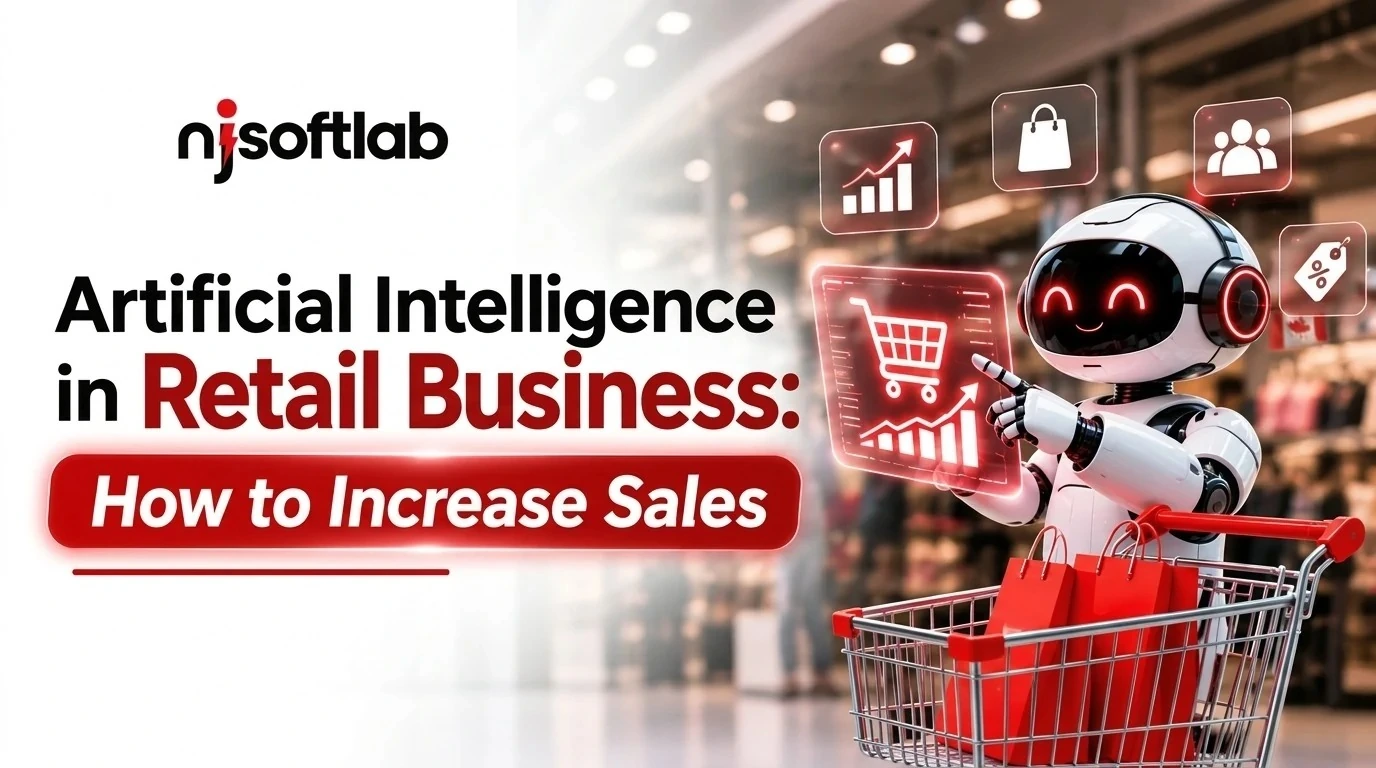
Artificial intelligence in retail business helps retailers make better decisions using sales, inventory, and customer data. From predicting product demand to personalizing shopping experiences, AI can automate repetitive tasks, reduce waste, and support business growth.
Retailers of all sizes can explore AI solutions to improve operations and customer experiences. The key is choosing applications that solve real business problems and deliver measurable value.
In this guide, we explain how AI works in retail, where it can reduce costs, how it can increase sales, and how to implement it effectively.
What Is Artificial Intelligence in Retail Business?
Artificial intelligence in retail business refers to using AI technologies to improve decisions about products, pricing, inventory, customers, and daily operations.
Common applications include:
- Machine learning: Identifies patterns in historical sales and customer data.
- Predictive analytics: Forecasts product demand and purchasing trends.
- Generative AI: Creates product descriptions, marketing content, and customer responses.
- Computer vision: Analyzes images and video to monitor shelves and identify potential inventory issues.
- AI agents: Carry out defined tasks, such as processing requests or triggering stock-related workflows, with appropriate permissions.
Unlike traditional software that follows fixed rules, AI can identify patterns in data and help retailers make more informed decisions.
Why Retailers Are Adopting AI
Retailers are exploring AI to improve efficiency, respond to changing customer expectations, and manage increasingly complex operations.
Three factors are driving adoption:
- Accessible tools: Subscription-based AI platforms make it easier for smaller businesses to test AI applications.
- Workflow automation: AI can assist with customer inquiries, product information, inventory monitoring, and repetitive administrative tasks.
- Personalized experiences: Retailers can use customer preferences and purchasing patterns to provide more relevant recommendations and offers.
The value of AI depends on how well a solution fits the retailer’s needs, data, and existing systems.
How Artificial Intelligence in Retail Business Reduces Costs
AI can help retailers control operating expenses by improving inventory decisions, automating routine tasks, and identifying problems earlier.
Demand Forecasting and Inventory Management
Ordering too much stock ties up cash, while ordering too little can lead to missed sales. AI-powered demand forecasting analyzes historical sales, seasonal patterns, and other relevant data to estimate future demand.
Retailers can use these insights to:
- Reduce overstocking and unnecessary markdowns.
- Identify products at risk of running out.
- Improve purchasing and replenishment decisions.
- Reduce spoilage for food retailers.
Metrics to track: Stockout rate, inventory turnover, and markdown rate.
AI Chatbots for Customer Support
Retail support teams often handle repetitive questions about delivery, returns, product availability, and order status.
AI chatbots can answer common questions around the clock and transfer complex inquiries to human staff. This helps businesses respond more efficiently while allowing employees to focus on issues that need personal attention.
Metrics to track: Average response time, resolution rate, and support cost per inquiry.
Learn more in our guide to AI chatbots vs. traditional chatbots.
Computer Vision for Loss Prevention and Shelf Monitoring
Computer vision uses AI to analyze images and video. In retail stores, it can help identify empty shelves, monitor product placement, and flag potential inventory discrepancies or suspicious activity.
These insights can help staff respond to stock issues more quickly and investigate potential losses.
Metrics to track: Shelf availability, inventory discrepancies, and shrinkage rate.
Automation of Back-Office Operations
Retailers spend time processing invoices, updating orders, coordinating suppliers, and handling routine administrative tasks.
AI automation can streamline these workflows, organize information, and flag exceptions for review. Connecting automation tools with existing business systems can further reduce manual work.
Metrics to track: Hours saved, processing time, and error rate.
Cost challenge | AI application | Metric to monitor |
Overstocking | Demand forecasting | Markdown rate |
Stockouts | Inventory management | Stockout rate |
High support volume | AI chatbots | Cost per inquiry |
Inventory losses | Computer vision | Shrinkage rate |
Manual processes | Workflow automation | Hours saved |
How AI Helps Retail Businesses Increase Sales
Artificial intelligence in retail business can support sales growth by improving product recommendations, marketing, pricing decisions, and the shopping experience.
Personalized Product Recommendations
AI analyzes browsing activity, previous purchases, and customer preferences to recommend relevant products.For example, an online store selling running shoes could recommend socks or insoles to someone browsing footwear.
Personalized recommendations can help retailers improve product discovery, increase average order value, and encourage repeat purchases.
Dynamic Pricing Strategies
AI-powered pricing tools analyze demand, stock levels, and market conditions to help retailers evaluate pricing opportunities.
Businesses can use these insights to adjust promotions, manage slow-moving products, and protect profit margins. Pricing decisions should follow clear rules to avoid confusing customers or undermining trust.
AI-Powered Retail Marketing
Generative AI can help retailers create product descriptions, email campaigns, advertising copy, and social media content more efficiently.
AI can also identify customer segments based on purchasing behaviour, helping businesses tailor campaigns to different audiences. Human review remains important for accuracy, brand consistency, and customer relevance.
Conversational Shopping and AI Agents
AI-powered shopping assistants allow customers to describe what they need in everyday language.
For example, a shopper could ask for a gift under $50 and receive relevant product suggestions. Depending on the system, an assistant can also answer product questions, compare options, and help customers find suitable items.
Examples of Artificial Intelligence in Retail Business
Different retailers can use AI to address specific operational challenges. The following are illustrative scenarios, not verified client case studies.
Online fashion store: An AI sizing assistant and improved product descriptions could help shoppers make more informed purchasing decisions and potentially reduce avoidable returns.
Grocery retailer: Demand forecasting based on sales history and seasonal patterns could help improve stock availability and reduce food waste.
Physical retail store: Computer vision alerts and automated customer support could help staff identify inventory issues and respond to common inquiries more efficiently.
The right solution depends on each retailer’s business model, available data, budget, and priorities.
How to Start Using AI in Your Retail Business
Retailers can begin with one clearly defined problem rather than automating every process at once.
- Identify a business problem. Choose a measurable challenge, such as frequent stockouts, high support volume, or time-consuming manual work.
- Review your data. Check that sales, inventory, and customer information is accurate and accessible.
- Choose the right solution. Off-the-shelf tools may suit common requirements, while custom software can support specialized workflows.
- Run a pilot project. Test the solution with one store, product category, or workflow.
- Measure performance. Compare results against a baseline using metrics such as processing time, stockout rate, or conversion rate.
- Scale what works. Expand the solution only when the results justify further investment.
Before implementation, establish clear responsibilities, train employees, and review security and privacy requirements.
Common Challenges of AI in Retail
Although AI can improve retail operations, businesses need to address several challenges before implementation.
- Poor data quality: Incomplete or inconsistent data can produce unreliable results.
- System integration: Older platforms may require additional work to connect with AI tools.
- Privacy and security: Retailers must protect customer information and comply with applicable privacy requirements, including PIPEDA where relevant.
- Employee adoption: Staff need training and a clear understanding of how AI will affect their workflows.
- Unrealistic expectations: AI does not guarantee higher sales or lower costs. Businesses should test solutions against measurable objectives.
A clear implementation plan and a limited pilot can help retailers evaluate a solution before making a larger investment.
What Is the Future of AI in Retail?
AI in retail is developing in three important areas:
- AI agents: Systems that can complete defined business tasks with appropriate permissions and oversight.
- Conversational shopping: Tools that help customers find products by describing their needs in natural language.
- Connected retail systems: Better coordination between online stores, physical locations, inventory, and customer service.
Retailers can prepare by improving data quality, reviewing existing systems, and focusing on AI applications that address practical business needs.
Final Thoughts
Artificial intelligence in retail business can help retailers reduce operational costs, improve inventory decisions, personalize shopping experiences, and streamline everyday work.
The best approach is to identify one clear business problem, choose an appropriate AI solution, and measure the results before expanding.
NJ Softlab helps businesses explore technology solutions aligned with their operational needs. Retailers considering AI automation or connected online shopping systems can explore our e-commerce services or contact our team to discuss their requirements.
Frequently Asked Questions
What Is Artificial Intelligence in Retail Business?
Artificial intelligence in retail business uses technologies such as machine learning, predictive analytics, and generative AI to improve inventory management, customer service, pricing, and shopping experiences.
How Does AI Reduce Costs in Retail?
AI can help reduce costs by improving demand forecasting, preventing unnecessary inventory buildup, automating repetitive tasks, and identifying stock discrepancies earlier.
How Does AI Increase Retail Sales?
AI supports sales through personalized recommendations, targeted marketing, pricing insights, and shopping assistants that help customers find relevant products.
Is AI Affordable for Small Retail Businesses?
Many AI tools offer subscription-based plans that allow smaller retailers to start with one application. Costs depend on the software, integration requirements, and ongoing maintenance.
What Is the Best AI Solution for a Retail Business?
The best solution depends on the main business challenge. Retailers experiencing frequent stockouts might start with demand forecasting, while businesses handling large volumes of repetitive questions could explore AI chatbots.
Is Customer Data Safe When Using AI?
Customer data can be protected through secure integrations, access controls, data minimization, and careful vendor selection. Businesses should review how AI tools collect, store, and process information and comply with applicable privacy requirements.
Will AI Replace Retail Workers?
AI can automate repetitive tasks, but retail businesses still need people for customer relationships, complex decisions, and personalized service. The goal is to use automation to support employees and improve operations.