- Q: Is generative AI safe for business use?
A: It can be, but 91% of organizations admit they haven’t done enough to protect customer data inside AI tools. - Q: What’s the biggest AI risk Canadian companies miss?
A: Employees entering confidential data into public AI tools that use it for model training without clear opt-out steps. - Q: Does the EU AI Act affect Canadian businesses?
A: Yes. If you serve EU customers, high-risk AI obligations kick in fully by August 2026, with fines up to €35 million. - Q: What’s the first step toward responsible AI use?
A: Classify your data before you let any AI tool touch it. That single step eliminates most accidental exposure risk.
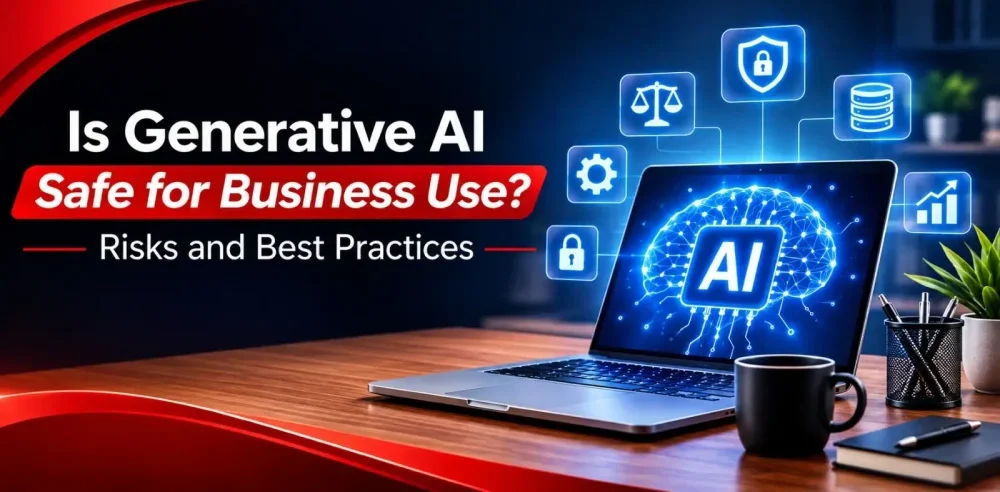
Generative AI is not inherently unsafe for business, but it carries real risks that most companies have not addressed. According to the Cisco 2026 Data Privacy Benchmark Study, organizations still cite a lack of formal oversight and insufficient privacy controls as the top issues with AI use. Businesses that classify data, set usage policies, and audit AI tools regularly can use generative AI productively without exposing customer information or violating data regulations.
Is Generative AI Safe for Business Use in Mississauga, Canada?
In 2026, over 80% of organizations worldwide are expected to have generative AI tools active in their production environments, yet most of them built those deployments before writing a single governance policy. For businesses in Mississauga and across Canada, that gap between adoption speed and risk preparedness is where the real exposure lives.
Canada’s regulatory environment is not standing still either. While GDPR applies to any business serving EU customers, Canada’s own PIPEDA and Quebec’s Law 25 both place direct accountability on companies that allow third-party AI tools to process personal data. That means the risk is not just theoretical. It sits inside your team’s daily workflow every time someone pastes a client email into a chatbot.
What Does “Safe” Actually Mean When We Talk About Generative AI?
Safety in the context of generative AI means different things depending on where you sit in the organization. For a CEO, the concern is data leakage. For a legal team, it’s IP liability and regulatory exposure. For IT, it’s uncontrolled tool proliferation. According to the World Economic Forum’s Global Cybersecurity Outlook 2026, data leakage through generative AI is the single most-cited security concern among CEOs, flagged by 30% of respondents.
That number matters because it reflects something that used to be invisible: most AI risk does not come from a cyberattack on your systems. It comes from your own employees using tools you may have approved without understanding what those tools do with the data fed into them.
The Cisco 2024 Data Privacy Benchmark Study found that 62% of users had entered details about internal business processes into generative AI applications, 48% had entered non-public company information, and 45% had included employee names or related details. These are not malicious actors. They are people trying to get work done faster, using the tools in front of them.
The Five Risks That Actually Cost Businesses Money
- Training data exposure
Most public generative AI tools, by default, use conversations to improve their models. When an employee submits a client contract summary or internal pricing strategy to get a rewrite, that content may enter a training pipeline. Research from multiple academic reviews in 2025 confirmed that large language models demonstrate a tendency to memorize and reproduce personally identifiable information from their training data. That is not hypothetical. It is a documented model behavior.
- Hallucination and factual error
About 37% of US adults aware of generative AI cite factually incorrect outputs as their primary concern. In business contexts, a hallucinated statistic in a client proposal or an incorrect regulatory detail in a compliance document can trigger real legal liability. The risk is not the AI being wrong in a vacuum. It is a human presenting that output as verified.
- IP and copyright liability
When AI tools generate text or code, the ownership of that output remains legally contested in most jurisdictions. The EU AI Act’s August 2026 deadlines require high-risk AI systems to document their data sourcing. If you cannot show clean IP lineage on AI-generated assets, you carry potential infringement exposure, particularly in creative, legal, and software contexts.
- Shadow AI and agent sprawl
Gartner projects that Fortune 500 companies will have 150,000 or more active AI agents by 2028, compared to fewer than 15 in 2025. The gap between those two numbers is mostly unmanaged. Employees adopt AI tools outside IT procurement, connect them to shared drives or email accounts, and no one maintains an inventory of what has access to what. That is not a future risk. It is already happening in mid-size companies across Ontario.
- Regulatory non-compliance
The EU AI Act carries fines starting at €7.5 million or 1.5% of global revenue for violations, scaling to €35 million or 7% of worldwide revenue for the most serious breaches. Canadian businesses with EU operations or EU-based customers need compliance posture ready now, not after enforcement begins.
Why “Just Use a Privacy Mode” Is Not Enough
Many business owners respond to AI risk by switching to the privacy setting in whichever AI tool they prefer, or by purchasing an enterprise plan that promises not to train on their data. That is a reasonable first step, but it addresses only one layer of the problem.
The deeper issue is that most organizations have no classification system telling employees what data can enter any AI tool at all. Without that, a privacy-mode subscription does not prevent someone from pasting a patient record, a pending M&A detail, or a client’s financial projection into a prompt. The container changed, but the behavior did not.
The Cisco 2026 Data Privacy Benchmark Study noted that companies moving away from outright AI bans found that blanket prohibitions are difficult to enforce. What actually works is a layered policy: define which data classifications are permitted in AI contexts, require contractual disclosures from AI vendors about data use, and include AI environments in your regular data discovery cycles.
For companies that need a structured approach to building that policy layer, NJ Softlab’s Generative AI Services help businesses in Mississauga and across Canada design AI adoption frameworks that address data classification, vendor assessment, and employee usage guidelines without slowing down the productivity gains that made AI attractive in the first place.
Generative AI Risk Options: How Do the Approaches Compare?
| Approach | Data Protection | Compliance Coverage | Scalability | Cost |
| Public AI tools (free tier) | Low | None | High | Free |
| Enterprise AI plan (privacy mode) | Medium | Partial | High | $$$ |
| Private/on-premise AI deployment | High | Strong | Moderate | $$$$ |
| Managed AI governance framework | High | Full | High | $$ |
The table above reflects where most mid-size businesses in Canada actually land: paying for enterprise plans while skipping the governance layer entirely. That combination produces medium data protection at high cost with no real compliance coverage.
The managed governance framework row describes what separates companies that scale AI confidently from those that scramble after an incident. It does not require building everything from scratch. It requires applying existing policy frameworks to your specific AI toolset, and auditing that application regularly.
Businesses that want an external team to run that audit without disrupting internal operations can explore NJ Softlab’s Cybersecurity Services, which cover AI risk assessment alongside traditional security controls. The Mississauga team brings over 10 years of experience helping Canadian organizations identify the gaps that internal IT teams are too close to spot.
What Responsible AI Use Actually Looks Like in Practice
Responsible AI adoption in 2026 is not about limiting use. It is about structured use. Organizations that treat AI governance as a strategic forethought rather than a retrofit are realizing measurable business returns, according to research from Alation published this year.
Here is what that structure looks like in practical terms for a Canadian business:
Data classification before deployment. Before any team member uses an AI tool, your organization needs a data classification framework that defines what is public, internal, confidential, and restricted. AI tools should only touch public and internal-tier data without additional controls.
Vendor due diligence. Every AI vendor your company uses should be required to disclose how they store prompts, whether they use inputs for training, what their data residency practices are, and how they respond to a data request or breach. This should be a contractual requirement, not a trust assumption.
Employee training with specifics. Most AI training materials tell employees not to enter sensitive data. Almost none tell employees how to recognize what counts as sensitive in the context of AI tools specifically. That specificity is what changes behavior.
Audit logging for AI outputs. When AI generates a recommendation, a document, or a decision input, that output should be logged with the date, the tool used, and the human who reviewed it. This serves dual purposes: regulatory documentation and quality control over time.
A central AI tool registry. Your IT team should maintain an approved list of AI tools, who owns each deployment, what data scope it has, and when it was last reviewed. That registry is the structural answer to shadow AI and agent sprawl.
Building these five practices does not require a large team. It requires intentionality and a partner who has done it before.
Key Takeaways
- Over 80% of organizations globally now use generative AI in production, but most lack formal oversight policies that protect customer and business data.
- The biggest risk is not a cyberattack. It is employees entering confidential business information into public AI tools that use it for model training.
- Data classification is the single highest-leverage action: define what data is permitted inside AI tools before deploying usage policies.
- The EU AI Act’s full high-risk obligations apply from August 2026, affecting any Canadian business with EU customers, with fines up to €35 million for serious breaches.
- Enterprise AI subscriptions reduce some risk but do not replace a governance framework that covers vendor assessment, employee behavior, and audit logging.
- Shadow AI is already present in most mid-size companies: employees adopt unapproved tools that connect to shared drives and email without IT visibility.
- Businesses that build AI governance as a core capability before scaling adoption avoid the reactive, expensive fixes that follow an incident.
FAQ
Q: Is generative AI safe to use for business purposes in 2026?
A: Generative AI is safe when paired with proper governance. The risk is not the technology itself but the absence of policies covering what data enters AI tools, which vendors process that data, and how outputs are reviewed. Organizations that address those three areas can use AI productively without meaningful exposure.
Q: What is the main data privacy risk of using ChatGPT or similar tools for work?
A: The core risk is that many AI tools use user inputs to train their models by default. If an employee submits a client contract, confidential pricing, or internal strategy into a prompt, that content may be retained and influence future outputs for other users. Switching to an enterprise plan with privacy mode reduces but does not eliminate this risk.
Q: Does Canada have AI-specific data regulations businesses must follow?
A: Canada’s PIPEDA governs how personal information is handled by private sector organizations, and Quebec’s Law 25 added stricter requirements around automated decision-making and data transparency. Businesses serving EU customers also face the EU AI Act’s full high-risk obligations starting August 2026.
Q: What is “shadow AI” and why should Canadian businesses care?
A: Shadow AI refers to AI tools employees adopt and use without IT approval or oversight. These tools often connect to email accounts, shared documents, or internal databases, creating data exposure that IT teams cannot monitor. Gartner projects this problem will reach significant scale by 2028 if left unaddressed.
Q: How do I know if my business needs an AI governance framework?
A: If your team uses any generative AI tool and you cannot answer these three questions with specifics, you need a framework: What data is permitted inside AI tools? Who approved the vendors currently in use? When was the last time you audited what AI has access to?
Q: Can a small business in Mississauga realistically implement AI governance?
A: Yes. AI governance does not require a dedicated compliance team. It requires a data classification policy, a short vendor assessment checklist, and an approved tool registry. Most small businesses can implement a working baseline in a few weeks with the right guidance.
Q: How does NJ Softlab help businesses use generative AI safely in Canada?
A: NJ Softlab’s Generative AI Services help Canadian businesses design adoption frameworks covering data classification, vendor due diligence, and employee usage policies. Their Cybersecurity Services complement that with AI risk audits and SOC support. You can reach the Mississauga team at +1 (888) 230-7357 or info@njsoftlab.ca.
Q: What should a business do first if they have employees already using AI tools without a policy?
A: Start with an AI tool inventory. Ask every team to list which AI tools they currently use, how often, and what type of information they put into them. That discovery step reveals the actual risk surface and gives you a prioritized list of what to address first before writing any formal policy.